
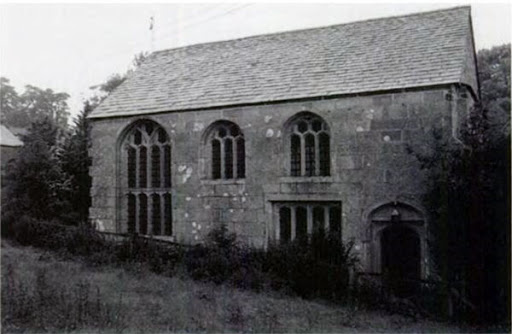
Trecarrell Manor
At Trecarrell there is evidence of a 2nd Neolithic camp; a Bronze Age burial site; an early Mediaeval village and a former Deer park, with a scattering of very large carved granites.
The grandest building is the Great Hall. This early 16th century hall was built by Sir Henry Trecarrel and was intended to be part of a large mansion but never completed. The worked granites however were gifted to rebuild four local churches with the outstanding one at the intrinsically carved granite church, St Marys at Launceston.
The Great Hall is impressive with fine perpendicular windows and an oak wagon roof. The detached Ladye chapel dedicated to St Mary Magdalene was licenced 1383 and constructed along the St Mary and St Michael lay line which wends its way to Glastonbury.
The present building circa 1500 AD is built on the foundations of an earlier Christian oratory, circa 600 AD and has three large tracery headed windows and four buttresses. The Grade 1, Great Hall, Chapel, and Manor house, have undergone extensive restorations from 1960.
King Charles 1st spent the night at Trecarrell, the home of Ambrose Manaton, on 1st August 1644 with an army of 27,000 men. Its stained-glass windows, sadly no longer there, were so impressive that they were documented in the Kings diary.
In 1821 it was the home of Antony Geake whose two false periods of imprisonment led to a change in the Tithe laws in 1831 when Tithes could be honoured by monetary payments.